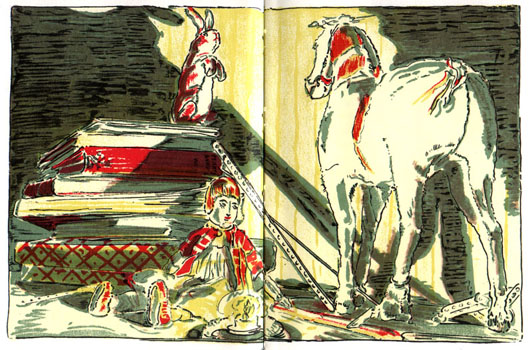
"Real isn't how you are made," said the Skin Horse. "It's a thing that happens to you. When a child loves you for a long, long time, not just to play with, but really loves you, then you become Real."
"Does it hurt?" asked the Rabbit.
"Sometimes," said the Skin Horse, for he was always truthful. "When you are Real, you don't mind being hurt."
"Does it happen all at once, like being wound up," he asked, "or bit by bit?"
"It doesn't happen all at once," said the Skin Horse. "You become. It takes a long time. That's why it doesn't often happen to people who break easily, or have sharp edges, or who have to be carefully kept. Generally, by the time you are Real, most of your hair has been loved off, and your eyes drop out, and you get loose in the joints and very shabby. But these things don't matter at all, because once you are Real, you can't be ugly, except to people who don't understand."
Source: The Velveteen Rabbit
"She couldn't go back and make the details pretty, she could only move forward and make the whole beautiful." - Terri St. Cloud
Showing posts with label emotions. Show all posts
Wednesday, July 13, 2011
Don't turn your back on the possibility
To embrace one's brokenness, whatever it looks like, whatever has caused it, carries within it the possibility that one might come to embrace one's healing, and then one might come to the next step: to embrace another and their brokenness and their possibility for being healed. To avoid one's brokenness is to turn one's back on the possibility that the Healer might be at work here, perhaps for you, perhaps for another.
Source: Robert Benson, Living Prayer
inward/outward
Source: Robert Benson, Living Prayer
inward/outward
Monday, July 04, 2011
Soul Gardens
Here's the link to the talk I gave last week at church - I was really happy with the way it all came together:
Soul Gardens
Soul Gardens
Saturday, December 11, 2010
This is why the questions are important
If the world is to change, first I have to change. The way I change (often kicking and screaming) is by coming to where the abyss of faith is located. I believe in a new way: not by suppressing the questions and the doubts, but by living more and more deeply into the questions and the doubts. I come to faith in a God who is paradoxically revealed in the very struggle to name God. The closer I get, the more I am questioned in my questioning, the more I am probed in my probing. I begin to wonder how it all fits together, especially when I don't fit together too well myself. I feel naked and exposed and frightened....
My fear and anger are very useful, provided I am able to resist that first panicked impulse to run. If I stand still in whatever cave I've been pushed into, my anger and fear can be a means to my understanding more clearly and with precision what is going on, not only within me but in the world.... Doesn't God reveal God's self in the areas of our greatest weakness--in our questioning, our probing, our suffering and our anger? I believe God does. This is why the questions are important. They stretch and enlarge the heart so that it is capable of receiving a deeper revelation. They expand our horizons. It would be strange if we didn't find this enlarging and expanding process deeply disturbing.
The simple truth is that reality reveals its secrets to us in proportion to the level of our willingness to ask questions. We receive "answers" to fit the kind of "questions" we pose. If our questions are narrowly and unimaginatively conceived, the answers will be, too.
Source: Alan Jones, Soul Making
via inward/outward
My fear and anger are very useful, provided I am able to resist that first panicked impulse to run. If I stand still in whatever cave I've been pushed into, my anger and fear can be a means to my understanding more clearly and with precision what is going on, not only within me but in the world.... Doesn't God reveal God's self in the areas of our greatest weakness--in our questioning, our probing, our suffering and our anger? I believe God does. This is why the questions are important. They stretch and enlarge the heart so that it is capable of receiving a deeper revelation. They expand our horizons. It would be strange if we didn't find this enlarging and expanding process deeply disturbing.
The simple truth is that reality reveals its secrets to us in proportion to the level of our willingness to ask questions. We receive "answers" to fit the kind of "questions" we pose. If our questions are narrowly and unimaginatively conceived, the answers will be, too.
Source: Alan Jones, Soul Making
via inward/outward
Sunday, November 22, 2009
Captured
“Ever since happiness heard your name, it has been running through the streets trying to find you.”
~Hafizvia swirly girl
Friday, September 18, 2009
Saturday, February 28, 2009
No Vacancy
Being alone with my thoughts and fears at the hospital with Jake these past few weeks has laid me bare in so many places. This quote from Henri Nouwen introduces a concept that I had never heard defined before - it resonates deeply with those bare places I am working through:
We are afraid of emptiness. Spinoza speaks about our "horror vacui," our horrendous fear of vacancy. We like to occupy-fill up-every empty time and space. We want to be occupied. And if we are not occupied we easily become preoccupied; that is, we fill the empty spaces before we have even reached them. We fill them with our worries, saying, "But what if ..."
It is very hard to allow emptiness to exist in our lives. Emptiness requires a willingness not to be in control, a willingness to let something new and unexpected happen. It requires trust, surrender, and openness to guidance. God wants to dwell in our emptiness. But as long as we are afraid of God and God's actions in our lives, it is unlikely that we will offer our emptiness to God. Let's pray that we can let go of our fear of God and embrace God as the source of all love.
Friday, August 17, 2007
The Story of our Desolation
As I am working through the 12 steps this time I am attempting to find spiritual disciplines that marry each step. Practices I can build into my life that not only enlarge my recovery, but also my spiritual life, shore up my emotional stability and find their way into my daily routine. As part of working Step 10 I began implementing the daily examen, never really knowing just how deeply this would open up my world. I have become more in touch with my own self because of this. I am finding truths about "me" that I had never given ear to before. The benefits of this bring so much life to not only my recovery but my well being and my relationship with God.
The guide I have been using for this has been Sleeping with Bread by the Linns. It has been incredible for me to find this simple, gentle way, written with such love and ease. It is truly a gift. At the end of the book there is a chapter of questions. I almost skipped this because they have done such a good job at answering my own I thought I wouldn't need it - I'm so glad I didn't. It's as rich as the chapters.
One of the major objections I have heard from people outside of recovery, most of them Christians, is that they struggle with the misconception that it dwells on the negative. "Hi my name is Heidi and I am a compulsive overeater" - I have heard that people think it labels the negatives instead of thinking on the positive healing that comes from recovery. I have also sensed from others through the years that people avoid it because they don't want to feel the negative emotions that come with recovery. That's what gets us into problems in the first place, right?
I have found the opposite to be true. Uncomfortable, difficult, but true.
The question asked in the book is:
You are encouraging me to be with and listen to desolation as well as consolation. I was taught to resist or go against desolation. Why are you saying the opposite?
An axiom that I have learned in recovery is "The good news is that you get your feelings back. The bad news is that you get your feelings back." I have found this to be true. All of the things that I had so stuffed down with food come back to me so frequently - and feeling the pain of the emotions is what got me into this in the first place, right? Actually, no. I have found that exactly the opposite is true. It is feeling the tinglings of the fear of the emotion and driving it away that got me here. If I had been taught how to own my emotions and fears instead of avoiding them I could have learned to do life without the crutches of my addictions.
The Linns answer the question this way:
The guide I have been using for this has been Sleeping with Bread by the Linns. It has been incredible for me to find this simple, gentle way, written with such love and ease. It is truly a gift. At the end of the book there is a chapter of questions. I almost skipped this because they have done such a good job at answering my own I thought I wouldn't need it - I'm so glad I didn't. It's as rich as the chapters.
One of the major objections I have heard from people outside of recovery, most of them Christians, is that they struggle with the misconception that it dwells on the negative. "Hi my name is Heidi and I am a compulsive overeater" - I have heard that people think it labels the negatives instead of thinking on the positive healing that comes from recovery. I have also sensed from others through the years that people avoid it because they don't want to feel the negative emotions that come with recovery. That's what gets us into problems in the first place, right?
I have found the opposite to be true. Uncomfortable, difficult, but true.
The question asked in the book is:
You are encouraging me to be with and listen to desolation as well as consolation. I was taught to resist or go against desolation. Why are you saying the opposite?
An axiom that I have learned in recovery is "The good news is that you get your feelings back. The bad news is that you get your feelings back." I have found this to be true. All of the things that I had so stuffed down with food come back to me so frequently - and feeling the pain of the emotions is what got me into this in the first place, right? Actually, no. I have found that exactly the opposite is true. It is feeling the tinglings of the fear of the emotion and driving it away that got me here. If I had been taught how to own my emotions and fears instead of avoiding them I could have learned to do life without the crutches of my addictions.
The Linns answer the question this way:
We agree that our attitude toward desolation is somewhat different than you may have been taught. Our present attitude is somewhat different from what we were taught, too. We were taught that many of our desolations, such as feelings of lust, anger, etc., were sinful. Sometimes such feeling states were called "capital sins." The truth in this teaching is that we need to resist the impulse to act upon feelings in a way that would be harmful to ourselves or others. For example, feelings of lust if acted upon might result in promiscuity, or feelings of anger if acted upon might result in violence.(Emphasis mine - especially the part about story!) Oh my - I just love it when something I believe to be true is affirmed elsewhere. It is so deeply moving to me. Like deep calling to deep. I think I need to read some Ignatius soon!
Yet this teaching often missed the distinction between acting upon feelings and listening to their story. Such teaching assumed that if we resisted certain feelings, they would go away. However, this isn't how our feelings work. When feelings are ignored or resisted, they grow inside us and are likely to eventually lead to an explosion in which we act out in even more destructive ways than we might have at first. We believe that what negative feelings or desolations really want is not destructive behavior but rather to have their story heard. When their story is heard they are satisfied and they quiet down naturally. If we then take steps to meet the needs revealed by the story, this desolation is unlikely to recur.
Our emphasis on hearing the story behind our desolation is consistent with the teaching of great spiritual writers like St. Ignatius. When, for example, we follow his suggestion to look at the beginning, middle and end of any temptation or his suggestion to discover the roots of what he called "sin," we are beginning to listen to the story of our desolation. Any process can help reveal the story of our desolation if it puts us in touch with what started it (the beginning), what keeps it going now (the middle) and what it needs to be resolved (the end). Contemporary psychology, which has helped us understand the nature of the unconscious, the dynamics of emotions and the results of emotional wounding, has given us new tools for hearing our desolations' story.
Labels:
12+steps,
daily+examen,
emotions,
recovery,
spiritual+disciplines
Subscribe to:
Posts (Atom)


