Saturday, October 24, 2015

Hiding

HIDING

is a way of staying alive. Hiding is a way of holding ourselves until we are ready to come into the light. Even hiding the truth from ourselves can be a way to come to what we need in our own necessary time. Hiding is one of the brilliant and virtuoso practices of almost every part of the natural world: the protective quiet of an icy northern landscape, the held bud of a future summer rose, the snow bound internal pulse of the hibernating bear.

Hiding is underestimated. We are hidden by life in our mother’s womb until we grow and ready ourselves for our first appearance in the lighted world; to appear too early in that world is to find ourselves with the immediate necessity for outside intensive care.

Hiding done properly is the internal faithful promise for a proper future emergence, as embryos, as children or even as emerging adults in retreat from the names that have caught us and imprisoned us, often in ways where we have been too easily seen and too easily named.

We live in a time of the dissected soul, the immediate disclosure; our thoughts, imaginings and longings exposed to the light too much, too early and too often, our best qualities squeezed too soon into a world already awash with too easily articulated ideas that oppress our sense of self and our sense of others. What is real is almost always to begin with, hidden, and does not want to be understood by the part of our mind that mistakenly thinks it knows what is happening. What is precious inside us does not care to be known by the mind in ways that diminish its presence.

Hiding is an act of freedom from the misunderstanding of others, especially in the enclosing world of oppressive secret government and private entities, attempting to name us, to anticipate us, to leave us with no place to hide and grow in ways unmanaged by a creeping necessity for absolute naming, absolute tracking and absolute control. Hiding is a bid for independence, from others, from mistaken ideas we have about our selves, from an oppressive and mistaken wish to keep us completely safe, completely ministered to, and therefore completely managed.

Hiding is creative, necessary and beautifully subversive of outside interference and control. Hiding leaves life to itself, to become more of itself. Hiding is the radical independence necessary for our emergence into the light of a proper human future.

...

Excerpted from ‘HIDING’ in CONSOLATIONS: The Solace, Nourishment and Underlying Meaning of Everyday Words.
2015 © David Whyte:
Now Available
http://davidwhyte.stores.yahoo.net/newbook.html

Aphrodite Born from the Sea Foam
Ludovisi Throne: Palazzo Altemps
Rome: October 2015
Photo © David Whyte

Monday, April 15, 2013

And you’ll do harm.

“[Jesus] has a lot to say about self-righteousness, which he compares, not very tactfully, to a grave that looks neat and well cared for up top, but is heaving with ‘corruption’ down below. Maggots, basically. And the point of this repulsive image is not just that the inside and outside of a self-righteous person don’t match, that there’s a hypocritical contradiction between the claim to virtue and the actual content of a human personality: it’s also that, for him, being sure you’re righteous, standing on your own dignity as a virtuous person, comes precious close to being dead. 

If you won’t hear the bad news about yourself, you can’t know yourself. You condemn yourself to the maintenance of an exhausting illusion, a false front to your self which keeps out doubt and with it hope, change, nourishment, breath, life. If you won’t hear the bad news, you can’t begin to hear the good news about yourself either. And you’ll do harm. 

You’ll be pumped up with the false confidence of virtue, and you’ll think it gives you a license, and a large share of all the cruelties in the world will follow, for evil done knowingly is rather rare compared to the evil done by people who’re sure that they themselves are good, and that evil is hatefully concentrated in some other person; some other person who makes your flesh creep because they have become exactly as unbearable, as creepy, as disgusting, as you fear the mess would be beneath your own mask of virtue, if you ever dared to look at it,” - Francis Spufford, from his recent book,Unapologetic.

Sunday, April 14, 2013

The biblical God is a starter kit


The biblical God is a starter kit

Karen Armstrong
Most of us are introduced to God at about the same time as we hear about Santa Claus, but over the years our views of Santa mature and change, while our notion of God often gets stuck at an infantile level.
As a result, “God” becomes incredible. Despite our scientific and technological brilliance, our religious thinking in the west is often remarkably undeveloped, even primitive, and would make Maimonides and Aquinas turn in their graves. They both insisted that God was not another being and that you could not even say that He (ridiculous pronoun!) existed, because our experience of existence is too limited. God, said Aquinas, is Being itself (esse se ipsum).
The biblical God is a “starter kit”; if we have the inclination and ability, we are meant to move on. Throughout history, however, many people have been content with a personalized deity, yet not because they “believed” in it but because they learned to behave – ritually and ethically – in a way that made it a reality. Religion is a form of practical knowledge, like driving or dancing. You cannot learn to drive by reading the car manual or the Highway Code; you have to get into the vehicle and learn to manipulate the brakes. The rules of a board game sound obscure and dull until you start to play, and then everything falls into place. There are some things that can be learned only by constant, dedicated practice. You may learn to jump higher and with more grace than seems humanly possible or to dance with unearthly beauty. Some of these activities bring indescribable joy –what the Greeks called ekstasis, a “stepping outside” the norm.
Religion, too, is a practical discipline in which we learn new capacities of mind and heart. Like premodern philosophy, it was not the quest for an abstract truth but a practical way of life. Usually religion is about doing things and it is hard work. Classical yoga was not an aerobic exercise but a full-time job, in which a practitioner learned to transcend the ego that impeded the ekstasis of enlightenment. The five “pillars” or essential practices of Islam are all activities: prayer, pilgrimage, almsgiving, fasting and a continual giving of “witness” (shahada) in everything you do that God (not the “gods” of ambition and selfishness) is your chief priority.
The same was once true of Christianity. The Trinity was not a “mystery” because it was irrational mumbo-jumbo. It was an “initiation” (musterion), which introduced Greek-speaking early Christians to a new way of thinking about the divine, a meditative exercise in which the mind swung in a disciplined way from what you thought you knew about God to the ineffable reality. If performed correctly it led to ekstasis. As Gregory of Nazianzus (329-90) explained to his Christian initiates: “My eyes are filled and the greater part of what I am thinking escapes me.” Trinity was, therefore, an activity rather than a metaphysical truth in which one credulously “believed”. It is probably because most western Christians have not been instructed in this exercise that the Trinity remains pointless, incomprehensible, and even absurd.
If you don’t do religion, you don’t get it. In the modern period, however, we have turned faith into a head-trip. Originally, the English word “belief”, like the Greek pistis and the Latin credo, meant “commitment”. When Jesus asked his followers to have “faith”, he was not asking them to accept him blindly as the Second Person of the Trinity (an idea he would have found puzzling). Instead, he was asking his disciples to give all they had to the poor, live rough and work selflessly for the coming of a kingdom in which rich and poor would sit together at the same table.
“Credo ut intellegam – I commit myself in order that I may understand,” said Saint Anselm (1033-1109). In the late 17th century, the English word “belief” changed its meaning and became the intellectual acceptance of a somewhat dubious proposition. Religious people now think that they have to “believe” a set of incomprehensible doctrines before embarking on a religious way of life. This makes no sense. On the contrary, faith demands a disciplined and practical transcendence of egotism, a “stepping outside” the self which brings intimations of transcendent meaning that makes sense of our flawed and tragic world.
Karen Armstrong is the author of “The Case for God: What Religion Really Means” (Vintage, £9.99

Tuesday, August 28, 2012

Kickstarter for a blogger friend


Our friend Milton has gotten published and is raising funds to promote his book - which is much more than a book - it is an experience - will you consider supporting him?

Keeping The Feast Book Tour Kickstarter Project

Thursday, June 14, 2012

Living with both arms

It costs so much to be a full human being that there are very few who have the enlightenment or the courage to pay the price.... One has to abandon altogether the search for security, and reach out to the risk of living with both arms. One has to embrace the world like a lover. One has to accept pain as a condition of existence. One has to court doubt and darkness as the cost of knowing. One needs a will stubborn in conflict, but apt always to total acceptance of every consequence of living and dying.

Morris West, The Shoes of the Fisherman

Via Inward/Outward

Thursday, May 03, 2012

God's math

"God doesn't go by the kind of arithmetic that you and I go by. God has never learned to deal in fractions. God didn't get that far in school. I think he's like my father who had ten children, and many a time I thought, "Well, my goodness, with a family this big, Daddy can't love me very much. I can only claim one tenth of his love." But my father loved me with all of his love. It's just that way with love. There is no fraction in it. You can't break it up into pieces. And God wants the whole human race. He just can't deal in fractions.

And so Jesus is saying to these people who were griping and mumbling and grumbling about the fact that he was taking in all kinds of people, bums and drunks and the poor folks and everybody, he was saying, "Well, I just can't help it. God just has a sentimental attachment for his people. And, whether you like it or not, God loves 'em, and it does seem to me that if they're precious in God's sight, they ought to be precious in yours, too."

Clarence Jordan, Cotton Patch Parables of Liberation

Friday, March 16, 2012

Brene Brown - Vulnerability and Shame @ TED

"Empathy is the antidote to shame.  If you put shame in a petri dish it needs three things to grow exponentially, secrecy,silence and judgement.  If you put the same amount of shame in a petri dish and dose it with empathy it cannot survive. The two most powerful words when we are in struggle is "me too."


Wednesday, February 22, 2012

Everything changes

The process of conversion begins with genuine openness to change--to be open to the possibility that just as natural life evolves, so our spiritual life is evolving.... Each time you consent to an enhancement of faith, your world changes and all your relationship have to be adjusted to the new perspective and the new light that has been given you. Our relationship to ourselves, to Christ, to our neighbor, to the Church--to God--all change. It is the end of the world we have previously known and lived in.

Source: Thomas Keating Contemplative Outreach News (Winter 1988)

via: inward/outward 

Thursday, February 16, 2012

Lie back and the sea will hold you

Lie back, daughter, let your head be tipped back in the cup of my hand.  Gently, and I will hold you.
Spread your arms wide, lie out on the stream, and look up, laugh at the gulls.  A dead man's float is face down.  You will dive and swim soon enough where this tidewater ebbs to the sea.

Daughter, believe that when you tire on the long thrash to the island, lie up, and survive.
As you float now, where I held you and let go,
Remember when fear cramps your heart what I told you:  Lie gently and wide to the light-year stars,
Lie back and the sea will hold you. ~Phillip Booth

Wednesday, February 15, 2012

It talks to me in tiptoes


"All This And Heaven Too"

And the heart is hard to translate
It has a language of its own
It talks and turns and courts sighs and present proclamations
In the grand days of great men and the smallest of gestures
And short shallow gasps

But with all my education I can’t seem to command it
And the words are all skipping and coming back all damaged
And I will put them back in poetry if I only knew how
I can’t seem to understand it

And I would give all this and heaven too
I would give it all if only for a moment
That I could just understand the meaning of the word you see
‘Cause I’ve been scrawling it forever but it never makes sense to me at all

And it talks to me in tiptoes
And sings to me inside
It cries out in the darkest night and breaks in morning light

But with all my education I can’t seem to command it
And the words are all skipping and coming back all damaged
And I will put them back in poetry if I only knew how
I can’t seem to understand it

And I would give all this and heaven too
I would give it all if only for a moment
That I could just understand the meaning of the word you see
‘Cause I’ve been scrawling it forever but it never makes sense to me at all

And I would give all this and heaven too
I would give it all if only for a moment
That I could just understand the meaning of the word you see
‘Cause I’ve been scrawling it forever but it never makes sense to me at all

No, words are a language that doesn’t deserve such treatment
That all of my stumbling phrases never amounted to anything worth this feeling

All this heaven never could describe such a feeling as I’m here

Words were never so useful ‘til I was screaming out a language that I never knew existed before

Friday, February 03, 2012

Still driven to try

"In order to arrive at the second half of life, one has to realize there is an incurable wound at the heart of everything. Much of the conflict from the age of twenty-five to sixty-five is just trying to figure this out and then to truly accept it. A Swiss theologian, Hans Urs Von Balthasar (1905-1988), said toward the end of his life: “All great thought springs from a conflict between two eventual insights: 1) The wound which we find at the heart of everything is finally incurable. 2) Yet we are necessarily and still driven to try.” (Think about that for an hour or so!)
Our largely unsuccessful efforts of the first half of life are themselves the training ground for all virtue and growth in holiness. This “wound at the heart of life” shows itself in many ways, but your holding and “suffering” of this tragic wound, your persistent but failed attempts to heal it, your final surrender to it, will ironically make you into a wise and holy person. It will make you patient, loving, hopeful, expansive, faithful, and compassionate—which is precisely the second half of life wisdom."
Starter Prayer:
Help me grow up by going down.

Thursday, January 26, 2012

How does a seed give thanks?

To give thanks is to recognize what has come to you.... How does the seed give thanks? It flowers. You take what you have, who you are, and you respond to the gift of that beingness with a course of action that aligns with it. You do what is in your nature.


Source: Patrice Vecchione, Writing and the Spiritual Life


Add your thoughts at inward/outward

Wednesday, January 25, 2012

Purity

"I did a study recently of how Jesus understood the ideas of purity or cleanliness. He never applies it to the body or the physical world, but only to motivations (Matthew 23:26) and to the heart (Matthew 5:8). In fact, he declares “all foods clean” (Matthew 7:19) in strong disagreement with his own Jewish tradition. Purity seems to be singleness of heart for Jesus, when I am not split, when I am “all here”. Impurity is mixed motivation, denial of parts of the picture, and self delusion. How different from most religion which has been preoccupied with purity codes, based in physical touching, eating wrong foods, seeing bad things, sexuality, and avoiding of “UnChristian” people and places. Again, Christian tradition has not followed its own teacher, and he was indeed a master teacher here." - Richard Rohr - Unpacking Paradoxes - Purity

Tuesday, December 20, 2011

i am of apollo

I have grown weary and worn and discouraged and even hurt by the dividing that happens in this "kingdom of God".  Wheat or tares, sheep or goats... Driscoll or Bell...  in or out... weren't we told by Jesus that was a job for the angels???

I am far from the place I began my journey sitting with my head covered, silent in that little Bible Chapel on Walworth Street in Lake Geneva, Wisconsin.

I have felt the sorting.  The dividing, the parsing into clubs that so many need to feel safe. I have been made to feel many times that I have stepped off that straight and narrow path I was raised on... how tragic it is that for me personally this path I tread now has lead me deeper and farther into my own heart and the heart of God than I have ever had before.

I found at a time, when everything tasted like dust, words and thoughts that very few in the kingdom would dare to utter.  They were life to me.  A clarion call through the fog that my spiritual life had become.  Creativity and soul and poetry and art were supposed to be a part of this journey, not a trivial waste of time or effort?!?!  I found those words in the mouth of a boy named Rob Bell... he was a punk kid at a conference I attended, in a little room at a big hotel, late at night while rock concerts were going on in the big room.  He had made a movie, it was like 6 minutes long... and nobody knew who he was.  He was humble, quirky and deep.  I liked him instantly.  There were only about two dozen of us in the room.  He talked about his idea to tell the truth, but tell it slant (not his words, but mine...errr. well Emily's)  And I have followed him since.

I never really had a pastor before that time, mostly they were my husbands bosses, or back in the old days pastors were not "biblical"... so Rob Bell became a pastor to me, far away, words listened to through my computer, films watched on dvd... words read on pages of quirky weird postmodern books, but they fed a part of my soul that had been starved since I was a child.  Life became much more full, I became much less morose and God incarnated within me and gave birth to a soul that I never dreamed could be possible.

Is this the path everyone should be walking? I don't think so, but for me I honestly can say it changed everything.  It may have even saved my life.  I have felt great shame for my emerging soul.  I have kept much of my writing and passion to myself because of that severe judgement and wrath sent upon the heads of those who stuck their necks out.  I have lost friends, family and relationships because of my journey.

My word for 2012 is BRAVE.  As a part of embracing that word I have decided that I'm going to let the chips fall where they may.  I'm tired of feeling ashamed for something that brings me great joy and life - and I'm done hiding my self, silencing my voice and folding myself into tiny little pieces to keep others mollified.  I will not argue. I will not debate. But I will not be silent any more.  More light than heat is what I long for.  I'm weary of that age old division, that snide looking down the nose of those who hold their faith in exclusive clubs.  I don't belong, I never have, but I have found a place where I have community, and deep conversation and inspiration and real life.  I am of Paul... I am of Apollo... I am finished.  I am beginning.

This morning I was pushed by the words I read, again, by Rob Bell in his farewell to his church, many of them have had to sit with the same judgement and disdain that I have felt - his response and encouragement to them took my breath away. 

"i write this to you because of how many of you have been
challenged about your participation in the life of this
church, often with the accusation: but what do they believe
over there at mars hill?
as if belief, getting the words right, is the highest form of
faith. Jesus came to give us life. a living, breathing, throbbing,
pulsating blow your hair back tingle your spine roll the
windows down and drive fast experience of God right
here, right now.
word taking on flesh and blood.
and so you've found yourself defending and explaining
and trying to find the words for your experience that is
fundamentally about a reality that is beyond and more than
words.
so when you find yourselves tied up in knots, having
long discussions about who believes what, a bit like
dogs doing that sniff circle when they meet on the sidewalk,
do this:
take out a cup
and some bread
and put it in the middle of the table,
and say a prayer and examine yourselves
and then make sure everybody's rent is paid and there's
food in their fridge and clothes on their backs
and then invite everybody to say
'yes' to the resurrected Christ with whatever 'yes' they
can muster in the moment and then you take that bread
and you dip it in that cup in the ancient/future hope and
trust that there is a new creation bursting forth right here
right now and
then together taste that new life and liberation and
forgiveness and as you look those people in the eyes gathered around that table from all walks of life and you see the new
humanity, sinners saved by grace, beggars who have
found bread showing the others beggars where they found it
remind yourselves that
this
is
what
you
believe.
remember, the movement is word to flesh.
beware of those who will take the flesh and want to turn it
back into words"

Beware of those who will take the flesh and want to turn it back into words...

I welcome you to break bread with me - to find the common in and amongst our uncommon ways.  I bless you on your path, and know that mine is mine alone - and I walk with those limping, misfit, rag tag bunch of ragamuffins I adore.

You can find the complete farewell here:  Rob Bell's Parting Epistle to Mars Hill:  Grace + Peace

Thursday, December 08, 2011

Fair Trade Christmas Gift Links

A friend posted a plea for help in finding fair trade Christmas gifts as their family gift exchange requirement was that all gifts be fair trade.  It's a great idea and I offered to help with the links that I have culled over the years - and instead of posting 15 different facebook updates I thought I'd put them all here so that she and anyone else looking can have this reference.  I will be happy to update the list if you leave me links in the comments with your favorite products and sites.  These are in no particular order and I am not affiliated or associate or benefiting from any of these links:

These are not necessarily "fair trade gifts" - but support great work on the ground in locations where these NGO's are located:

Hope that helps - by no means exhaustive - but will give you a good start :) (again, will gladly add any links to other fair trade items left in the comments)

Wednesday, September 14, 2011

Wonderstruck

I love Brian Selznick's original book The Invention of Hugo Cabret so much and cannot wait for the movie this Christmas - his second work Wonderstruck just released yesterday and I am excited to get my little hands on it.  Selznick not only authors the works, but uses the most detailed pencil sketches.

This book weaves two stories, one told in text, one told in illustrations together until they become one.  I cannot wait to read it.  Here is the beautiful teaser Scholastic put together for his new work.  Enjoy!
Don't miss the great article in Brain Pickings - Wonderstruck: Remarkable New Work from Brian Selznick

Monday, September 05, 2011

September resolutions

It seems to me that January resolutions are about will; September resolutions are about authentic wants.... The beauty of autumnal resolutions is that no one else knows we're making them. Autumnal resolutions don't require horns, confetti and champagne. September resolutions ask only that we open to positive change.

Source: Sarah Ban Breathnach, Simple Abundance via herondance.org

Saturday, August 13, 2011

Real

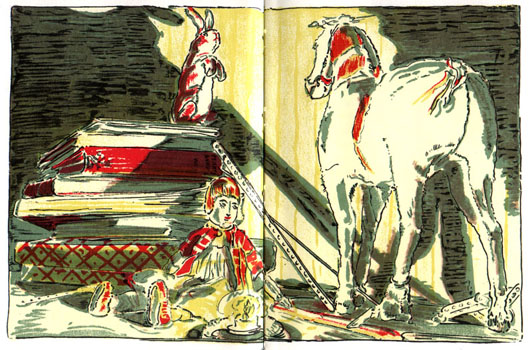
"Real isn't how you are made," said the Skin Horse. "It's a thing that happens to you. When a child loves you for a long, long time, not just to play with, but really loves you, then you become Real."

"Does it hurt?" asked the Rabbit.

"Sometimes," said the Skin Horse, for he was always truthful. "When you are Real, you don't mind being hurt."

"Does it happen all at once, like being wound up," he asked, "or bit by bit?"

"It doesn't happen all at once," said the Skin Horse. "You become. It takes a long time. That's why it doesn't often happen to people who break easily, or have sharp edges, or who have to be carefully kept. Generally, by the time you are Real, most of your hair has been loved off, and your eyes drop out, and you get loose in the joints and very shabby. But these things don't matter at all, because once you are Real, you can't be ugly, except to people who don't understand."

Source: The Velveteen Rabbit

Wednesday, August 10, 2011

The Fantastic Flying Books of Mr. Morris Lessmore

A small gift of a film landed in my lap today. I found myself feeling melancholy about the loss of my fall position as librarian and caretaker of the stories at the elementary school I have been working at for the past couple of years. Most of the time I don't dwell on it, but with the dreary rain today and the smell of fall in the air already my heart began to break again for the loss of those small wee faces upturned to hear me read to them my favorite stories and to help them find their own.

I can't even re-create the steps that brought me to Moonbot Studios website for morrislessmore.com but I was instantly enchanted. I poked through the site, watched all of the vimeos available and was hooked enough to lay down real money to download the short award winning film. It is stunning and heartfelt. Have not been so moved by film since the first 30 minutes of Pixar's Up.

It begins in New Orleans and tells the story of the hurricane stealing everyones stories. Miraculously no words are spoken but hope is restored for this community as Morris finds his own story again. Watch for the little red head at the end of the film... she too was a keeper of stories, even for a short time.

Please make sure to click through this link to watch a tiny preview - it won't let me embed it here - you won't regret it, promise.

The Fantastic Flying Books of Mr. Morris Lessmore

Monday, July 18, 2011

Humpback whale says thank you to the people who saved her

This is so moving - an incredible metaphor for freedom - the joy with which she explodes from the water afterward is magical.